
Telecom Routing Explained: How VoIP Calls Choose the Best Route
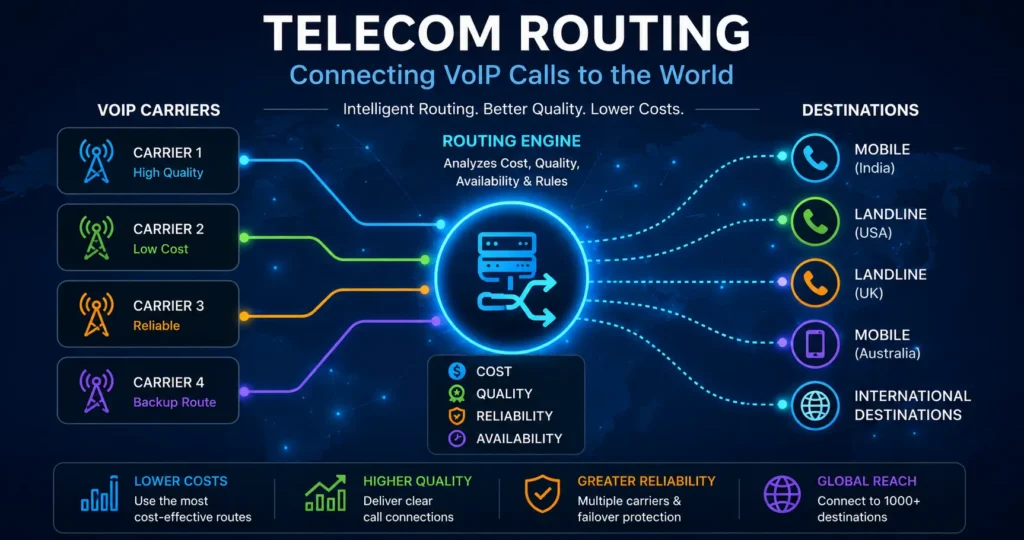
Telecom routing is the process of selecting and directing voice calls through the most suitable telecommunications network or carrier. In VoIP communications, routing decisions can affect call quality, reliability, cost, and connectivity.
Businesses and call centers often work with multiple carriers or routes, so choosing the right path for each call is important. A well-designed routing strategy can help balance cost with voice quality, availability, and network performance.
In this guide, we’ll explain how telecom routing works, how VoIP routing and least cost routing fit into the process, and what businesses should consider when choosing a telecom or VoIP route provider.
What Is Telecom Routing?
Telecom routing is the process of determining how a voice call travels from the originating number or network to its destination. When a call is placed, the routing system evaluates available carriers, routes, destinations, and network conditions to select an appropriate path for the call.
International telecommunications standards also address routing and network interconnection.
In traditional telecommunications and modern VoIP networks, routing helps connect calls efficiently between different carriers and networks. The selected route can influence the overall cost, voice quality, connection speed, and reliability of a call.
For businesses that handle a high volume of calls, telecom routing becomes especially important. Using multiple carriers and intelligently managing routes can help reduce service interruptions while maintaining consistent call quality.
Telecom routing can involve several strategies, including carrier-based routing, least cost routing (LCR), quality-based routing, and failover routing. The right approach depends on the business’s destinations, traffic volume, budget, and reliability requirements.
How Telecom Routing Works
Telecom routing works by evaluating an incoming call and determining which available network or carrier should handle the call to its destination. The routing system uses predefined rules and routing information to select an appropriate path.
A typical telecom routing process can be understood in these steps:
1. Call destination is identified
The system identifies the destination number, country, region, or network associated with the call.
2. Available routes are checked
The routing system checks the carriers and routes available for that destination.
3. Routing rules are applied
Rules may consider factors such as cost, call quality, carrier availability, destination, and network performance.
4. A suitable route is selected
The system selects the route that best matches the configured routing criteria.
5. The call is connected
The call is sent through the selected carrier or network toward the destination.
6. Failover can be used when necessary
If the primary route is unavailable or fails to meet the required conditions, a configured backup route can be used.
This process can happen automatically and in a very short time, allowing businesses and call centers to manage large volumes of calls across multiple carriers and destinations.
Telecom Routing vs. VoIP Routing
Telecom routing and VoIP routing are closely related, but they are not exactly the same. Telecom routing is a broader term that describes how voice traffic is directed between telecommunications networks, carriers, and destinations. VoIP routing focuses specifically on routing voice calls that use Voice over Internet Protocol technology.
In a VoIP environment, routing can determine which carrier or SIP route should be used for a particular destination. A business may use multiple VoIP carriers and apply routing rules based on destination, cost, quality, availability, or other network requirements.
The main difference is the scope:
- Telecom routing can cover voice traffic across traditional and IP-based telecommunications networks.
- VoIP routing specifically deals with voice traffic carried using IP networks.
- Carrier routing determines which available telecommunications carrier handles the call.
- Least Cost Routing (LCR) selects routes primarily based on configured cost considerations.
For modern businesses and call centers, VoIP routing is often an important part of the overall telecom routing strategy.
What Is Least Cost Routing (LCR)?
Least Cost Routing (LCR) is a telecom routing method that selects an available carrier or route based primarily on the cost of completing a call to a specific destination.
A business or VoIP provider may have several carriers available for the same destination. Each carrier can have different rates, availability, and routing conditions. An LCR system compares the configured rates and selects a suitable low-cost route according to the routing rules.
However, the cheapest route is not always the best route. Businesses should also consider factors such as call quality, answer rates, reliability, latency, and route availability when designing their routing strategy.
For this reason, modern telecom routing can combine cost-based routing with quality and failover rules. This can help businesses control communication costs without making price the only factor in route selection.
How Telecom Carriers Choose a Route
Telecom carriers and VoIP providers can use multiple routes to reach the same destination. The route selected for a call depends on the routing rules configured by the provider and the requirements of the traffic.
Several factors can influence route selection:
- Destination: The country, region, network, or number being called.
- Cost: The rate charged by the carrier for completing the call.
- Call quality: The expected voice quality and stability of the route.
- Availability: Whether the carrier and route are currently available.
- Capacity: Whether the route can handle the required volume of call traffic.
- Reliability: The historical performance and consistency of the route.
- Failover: Whether another route is available if the preferred route becomes unavailable.
A good routing strategy does not necessarily choose the cheapest carrier for every call. Instead, it can use a combination of cost, quality, availability, and reliability to determine the most suitable route for each destination.
Cost vs. Call Quality in Telecom Routing
Cost is an important consideration when selecting telecom routes, but it should not be the only factor. A route with a lower price may not always provide the call quality, reliability, or consistency required by a business.
When evaluating telecom or VoIP routes, businesses should consider both cost and performance. Important factors can include voice quality, answer rates, latency, routing stability, carrier availability, and the ability to handle expected call volumes.
A balanced routing strategy can prioritize different routes depending on the destination and business requirements. For example, a business may use a lower-cost route for suitable destinations while keeping a higher-quality alternative available for important traffic.
The goal is not simply to find the cheapest route. The goal is to achieve a practical balance between price, quality, reliability, and availability.
Route Failover and Redundancy
Route failover is a backup mechanism that allows a call to use an alternative route when the preferred carrier or route is unavailable or does not meet the configured requirements.
Failover is important because telecom networks can experience outages, congestion, routing problems, or carrier-specific issues. Without a backup route, these problems can prevent calls from connecting successfully.
A typical failover strategy may include:
- Primary route: The preferred carrier or route used under normal conditions.
- Secondary route: A backup carrier used when the primary route is unavailable.
- Additional backup routes: Alternative routes that can be used when multiple routing options are available.
- Routing rules: Conditions that determine when traffic should move from one route to another.
Combining route selection with failover can improve the resilience of a VoIP or telecom network. It allows businesses to maintain connectivity even when an individual carrier or route experiences a problem.
Common Telecom Routing Problems
Telecom routing can become difficult when a business depends on multiple carriers, destinations, and routing rules. Poorly managed routing can affect call quality, connection rates, costs, and overall reliability.
Some common telecom routing problems include:
- Poor call quality: Calls may experience audio problems, distortion, delay, or inconsistent voice quality.
- High call costs: Calls may be routed through unnecessarily expensive carriers or routes.
- Route failures: A carrier or route may become temporarily unavailable, causing calls to fail.
- Incorrect routing: Poorly configured routing rules can send calls through an unsuitable carrier or destination.
- Limited redundancy: Without backup routes, a carrier outage can have a greater impact on call connectivity.
- Capacity problems: A route may not have enough capacity to handle higher volumes of call traffic.
Regularly reviewing routing performance and maintaining appropriate backup routes can help businesses identify and reduce these problems.
How to Choose a Telecom Route Provider
Choosing a telecom route provider requires more than comparing the lowest advertised rates. Businesses should evaluate the provider’s route quality, destination coverage, reliability, support, and ability to handle their expected call traffic.
Before selecting a provider, consider the following factors:
- Destination coverage: Check whether the provider supports the countries, regions, and destinations your business needs.
- Route quality: Evaluate voice quality, connection performance, and consistency.
- Pricing: Compare rates across your important destinations and understand how pricing is structured.
- Reliability: Look for stable connectivity and appropriate backup or failover options.
- Scalability: Make sure the provider can support your expected call volume as your business grows.
- Technical support: Consider the availability and responsiveness of technical support when routing issues occur.
- SIP and VoIP compatibility: Confirm that the routes and services work with your existing VoIP infrastructure.
- Monitoring and reporting: Useful routing information and traffic monitoring can help identify performance or connectivity issues.
For businesses with significant voice traffic, testing routes before moving large volumes of calls can help identify potential quality or reliability issues.
Telecom Routing for Businesses and Call Centers
Businesses and call centers often handle a large volume of inbound and outbound voice traffic across different destinations. As call volumes increase, having a reliable telecom routing strategy can become important for maintaining connectivity, controlling costs, and supporting consistent call quality.
A business may use multiple carriers or VoIP routes to support different destinations and traffic requirements. Routing rules can help determine which route should be used based on factors such as destination, cost, quality, availability, and network conditions.
For call centers, routing and failover can be particularly important because interruptions can affect agents, customers, and ongoing campaigns. Maintaining alternative routes can provide additional resilience when a primary carrier or route becomes unavailable.
A well-planned routing strategy can help businesses:
- Manage voice traffic across multiple routes and carriers.
- Balance communication costs with route quality.
- Improve routing reliability through backup routes.
- Support different destinations and call volumes.
- Identify routing or connectivity problems through monitoring and reporting.
The right routing approach depends on the business’s call volume, destinations, infrastructure, quality requirements, and budget.
Frequently Asked Questions
What is telecom routing?
Telecom routing is the process of selecting and directing voice calls through an appropriate telecommunications network or carrier to reach the intended destination. Routing decisions can consider cost, quality, availability, reliability, and other network requirements.
How does VoIP routing work?
VoIP routing directs voice calls carried over IP networks through available carriers or routes. Routing rules can consider the destination, cost, quality, availability, and other requirements before selecting a suitable route.
What is least cost routing?
Least Cost Routing (LCR) is a routing method that selects a suitable available route based primarily on the cost of completing a call. Businesses can combine LCR with quality and failover rules so that cost is not the only routing consideration.
Why is call routing important?
Call routing helps businesses direct voice traffic through suitable carriers and network paths. Effective routing can help manage costs, maintain call quality, improve reliability, and provide alternative routes when a primary route becomes unavailable.
How do I choose a VoIP route provider?
Compare providers based on destination coverage, route quality, pricing, reliability, scalability, technical support, VoIP compatibility, and monitoring capabilities. Testing routes before sending significant call traffic can also help evaluate performance.
Conclusion
Telecom routing plays an important role in how voice calls are connected across carriers, networks, and destinations. A well-planned routing strategy can help businesses balance cost, call quality, reliability, and availability.
For VoIP providers and call centers, using appropriate routing rules, multiple carriers, and failover options can help create a more reliable voice infrastructure. The best routing approach depends on the destinations, call volumes, network requirements, and business priorities.
When evaluating a telecom route provider, businesses should look beyond price and consider route quality, reliability, destination coverage, scalability, technical support, and overall performance.